
The Looming Enforcement Trap
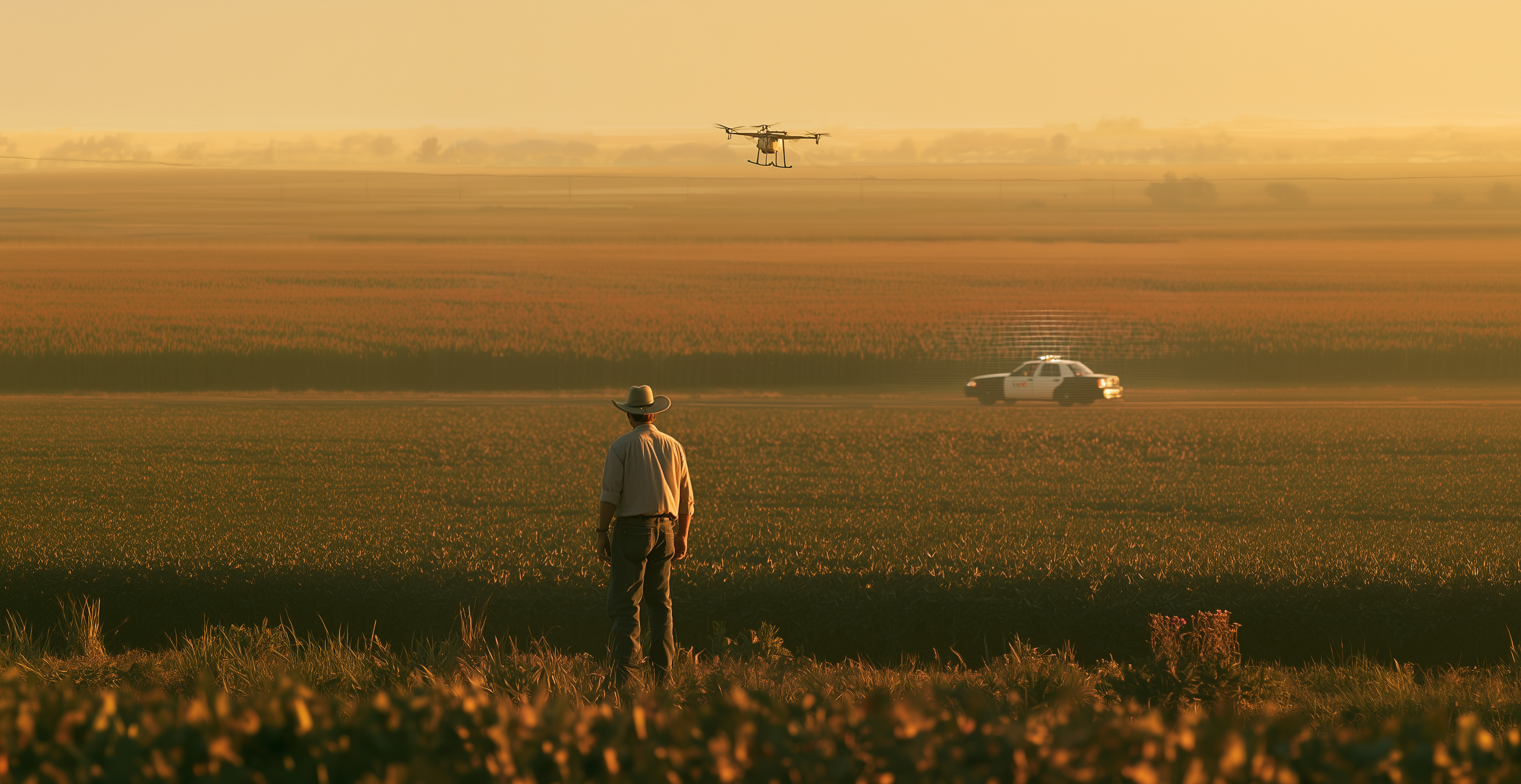
Hooray for visual metaphors!
On June 6, 2025, President Trump signed the two drone-focused Executive Orders. The headlines focused on the Drone Dominance E.O. and its promise of on-shoring and military UAS development, creating a robust American UAS industry, free from Chinese dominance. But, a provision in the accompanying Restoring American Airspace Sovereignty E.O. is slowly percolating through your state’s government and will catch many operators, particularly American farmers, off-guard both harder and sooner than most people realize. If this comes to pass without significant reform to FAA policy, state and local law-enforcement officers could unknowingly cause huge numbers of agricultural drone operators to receive six and seven figure fines in the coming years.
Q: Wow, that’s a sensationalist claim! How do you figure that?
A: Well, it’s kinda boring but that’s why most people missed it - so, while this is a pretty long article, know that I’m aware of that, but I didn’t want to leave things unaddressed - For the TLDR, skip to ‘The Worst Case’ header.
The order, titled "Restoring American Airspace Sovereignty," directed the FAA to provide automated, real-time access to the personal identifying information tied to drone Remote ID signals (note: that’s different than the passive ADSB discussion from Part 108) — handing that access not only to federal agencies but to state, local, tribal, and territorial governments. The same order steers Justice Department and Homeland Security grant dollars toward equipping those same local agencies to detect, track, and identify drones.
FAA Preemption and State Laws
The FAA has preemption over all airspace regulation in the United States, meaning that states must defer to the FAA’s rules regarding most anything that flies. This is not new, and so this may not seem like such a big deal - state and local police already arrest people for drone infractions all the time. But, when the addition of access to the Remote ID database + funding for detection and ID are combined, it creates a huge new issue: police are not just interacting with UAS when there is cause for police to be involved, such as an accident or misuse.
There is a critical distinction between referral authority — where a deputy who witnesses an incident responds to it and gathers facts to be passed to the FAA for subsequent charging and investigation where necessary — and passive validation, where a squad car equipped with a passive ID reader silently checks every drone in local airspace against a live federal registry, with no crime, no complaint, and no reported event required to trigger that check. The executive order started the ball rolling on passive validation, and it should be expected to be rolled out in every state in the coming years.
The Under-registration Problem in American Ag-Drones
To be clear, ADI's position on registration has never wavered: register your aircraft, and follow every applicable law and regulation. Much like a driver's license, compliance is required whether or not you are a responsible operator. But, sound policy-making deals with the reality on the ground, and the reality is that a significant majority of agricultural drones in operation today are unregistered.
Many farmers genuinely think of themselves as operating outside the national airspace system — flying ten to fifteen feet, rarely above fifty, over their own or their customers' fields. Given the notoriously long wait times for a Part 137 and its audit rights, combined with the immutable flight records on the drone (not to mention the FAA’s own admission in Part 108’s NPRM that Part 137 is not workable for agricultural drones), the current system affirmatively deters a farmer from ever registering.
FAA Penalties
The trap is in the math. The FAA's penalty structure was built for manned aviation, where enforcement runs per flight or per incident, and is capped at $75,000.00 per flight. Apply that per-flight logic to an ag operator who flies six to eight times an hour, across a ten-hour day, and the exposure quickly compounds. This is not hypothetical. In August 2026, the FAA proposed a $289,215.00 civil penalty against Gorge Drones over 15 flights.
Fifteen flights is the equivalent of about 2.5 hours of work - a rounding error against what a single operator logs in one intensive season. Not to mention that Gorge Drones was in the process of becoming compliant and, to our knowledge, was not executing night-flights, or other behavior that would further antagonize the FCC when they were assessing the fine. Even assuming a settlement at a third of the enforcement amount (a steep discount) that is still an unexpected $100,000.00 bill. A decade ago, that would have been catastrophic for an American farm. Today, for most small operations and a great many mid-size ones, it would be somehow more than catastrophic, and well-past fatal.
The Worst-Case (But Most Likely) Scenario
States are already reaching out to groups like ADI for input on how to craft these rules. That means states are pretty far along in the process, and none of the state personnel that we have spoken to seem to have been aware of the under-registration issue when we raised it with them.
The issue is this: The federal government is issuing the detection equipment grants. That means large numbers of state and local law enforcement across the country is going to get pretty high-end detection equipment, which they will be eager to take for a spin. The detection equipment will be installed by well-meaning people, not realizing what is about to happen. When they turn it on - intending to detect bad guys - the software will begin detecting these unregistered UAS operated by otherwise compliant and well-meaning farmers (e.g. if an ag-drone is being operated near a prison). Once the FAA logs the detection and the GPS coordinates, there is nothing to stop them from requiring the local law enforcement to go initiate investigations that will end in six- or seven-figure fines for the farmer.
Remember: Gorge Drones’ fine was for 15 flights over two months while they were trying to be compliant, and they were fined ~$19,000.00 per flight. What happens when the FAA finds someone who’s been spraying hot and heavy, day and night, over multiple seasons, without a whiff of an attempt at getting a Part 107, much less a 44807 or 137? Even 20 flights a day, for three months of the year, for two years (3,600 flights) would only need a baseline fine of $278.00 per flight to equal a $1,000,000.00 fine.
Can’t My State Do Something?
State and local law enforcement normally have enforcement discretion, such as giving you a warning for speeding. With the FAA database and the detection systems in place, the query, location, etc. are all logged systematically. There is no guarantee that the police officer who knows the farmer and is trying to effectively protect his community will have any say-so in what happens after the detection event, not to mention that, because of the FAA’s preemption rights, states could not even enact legislation to insulate their citizens from these onerous fines once levied.
Compounding the problem, the state cannot fix it through legislation. Local government is preempted from modulating FAA rules or penalties; it can detect and refer, but it cannot temper the strength of the FAA’s enforcement decision.
America’s farmers are already under enormous economic pressure - what would a bill for $100,000.00, much less $1,000,000.00 (which, being a fine, a bank is unlikely to issue a loan for), do to a farmer’s financial outlook?
To be clear, from the White House to the FAA to the State and Local Law Enforcement, this outcome is not the intent of anyone involved in this process, but that is why it is all the more critical to join ADI in the effort to enact meaningful FAA reform policy to facilitate agricultural UAS registration and make sure that American farmers are not left bearing the brunt of this well-meaning policy.